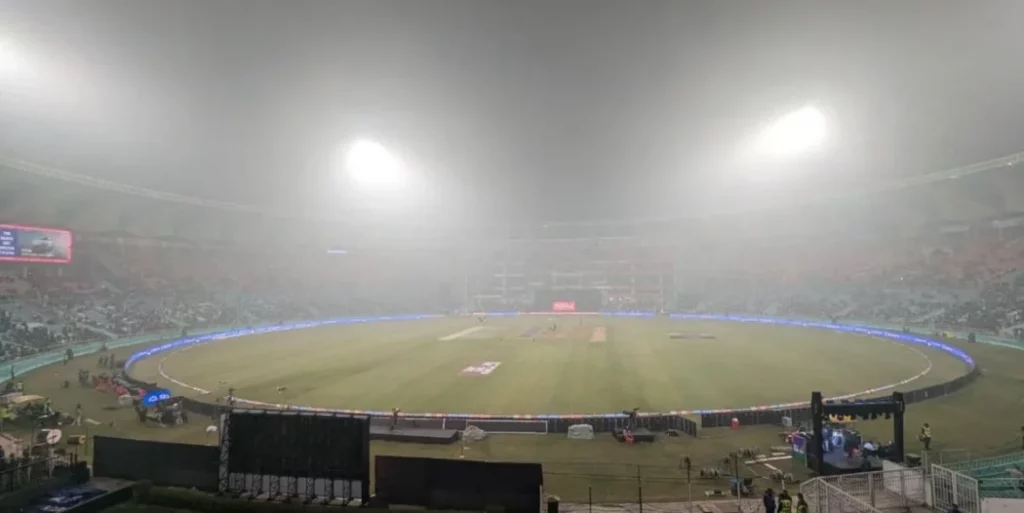
The fourth T20 International between India and South Africa, scheduled to be played at the Bharat Ratna Shri Atal Bihari Vajpayee Ekana Cricket Stadium in Lucknow on Wednesday, ended in disappointment as the India vs South Africa T20 Abandoned without a ball being bowled due to excessive fog.
The rare occurrence left thousands of spectators disappointed and sparked widespread discussion around air quality and environmental conditions in northern India.
The match officials were forced to delay proceedings after dense fog enveloped the stadium well before the scheduled toss time of 6:30 PM IST. Several pitch inspections were carried out over the next few hours in the hope that visibility would improve.
However, conditions continued to deteriorate as the evening progressed, prompting the umpires to call off the match at 9:25 PM IST officially.
In a brief statement, match officials confirmed that the fourth T20I “has been abandoned due to excessive fog, making playing conditions unsafe.” Safety concerns for players, umpires, and broadcast staff were cited as the primary reasons behind the decision.
The abandonment triggered strong reactions from fans both inside and outside the stadium. Many supporters took to social media to demand ticket refunds from the Board of Control for Cricket in India (BCCI), expressing frustration over the lack of play.
Images of Indian all-rounder Hardik Pandya wearing a face mask at the venue further fueled online debate, bringing attention to pollution levels in Lucknow.
According to air quality monitoring organisation IQAir, PM2.5 levels in parts of the city were recorded at 78 micrograms per cubic metre on Wednesday evening.
This figure is more than five times the daily exposure limit recommended by the World Health Organisation. Experts noted that cold temperatures, low wind speeds, and the trapping of pollutants from traffic, industrial activity, and crop burning contributed to the dense fog and smog that blanketed the region.
Rare Fog-Related Abandonments in Cricket
Cricket matches being abandoned due to fog are extremely uncommon, particularly in limited-overs formats.
One of the most notable examples dates back to 1998, when Pakistan’s third Test against Zimbabwe in Faisalabad was abandoned after all five days were lost to persistent fog and freezing conditions.
At the time, umpires conducted repeated inspections, but poor visibility made play impossible.
The Lucknow T20I now joins that rare list, underlining how extreme weather and environmental factors can disrupt even high-profile international sporting events.
Series Position and Final Match
Despite the no-result in Lucknow, India continues to lead the five-match T20I series 2-1. The hosts secured wins in the first and third matches held in Cuttack and Dharamsala, while South Africa claimed victory in the second T20I to keep the series alive.
The fifth and final T20I is scheduled to be played on Friday, December 19, at the Narendra Modi Stadium in Ahmedabad. With the T20 World Cup set to begin in February in India and Sri Lanka, both teams are expected to treat the series finale as a crucial opportunity to fine-tune their combinations.
The fog-induced abandonment in Lucknow has once again underscored the growing impact of environmental conditions on international cricket, raising significant questions about scheduling, air quality monitoring, and the overall matchday experience for players and fans alike.