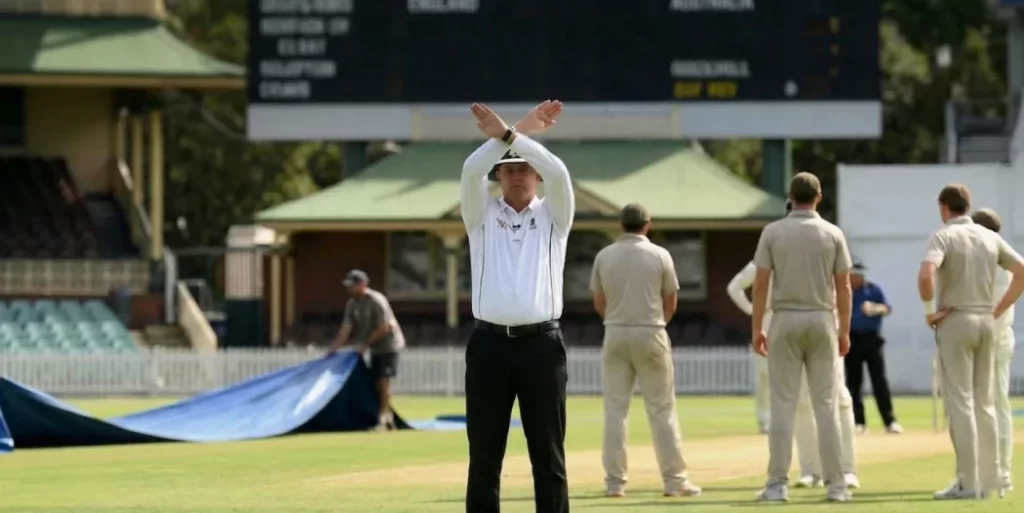
Cricket is one of the few sports where play can stop at any moment without warning. Weather, safety concerns or unexpected situations can bring everything to a sudden stop in the middle of action.
Fans watching live often wonder why play has paused and when it will restart. A match suspended situation can be confusing if you do not know what triggers it or what the rules say.
The suspended meaning in cricket is something every fan should know. It helps you understand what is happening on the field and why umpires have the final say over every stoppage decision made.
Whether you follow Test matches, ODIs or the IPL, stoppages happen in all formats. Knowing the reasons behind a cricket rain delay or any other suspension makes your viewing experience far more informed.
What Does Suspended Mean in Cricket?
Suspended meaning in cricket is the umpires have called a stop to play due to conditions that are unsafe or unfair. The decision always comes from the on-field umpires under MCC Law 2.8.
According to MCC Law 2.8.3, umpires must monitor conditions during any suspension and restart play the moment they both agree it is safe again. All scores and match progress remain fully intact during this time.
This rule applies across all formats Test matches, ODIs, T20s and the IPL. The suspended meaning in cricket stays the same whether it is an international game or a domestic league match.
Common Reasons Why a Cricket Match Gets Suspended
Several situations can lead to a match suspended in cricket. Understanding the suspended meaning in cricket helps fans know why the game has stopped. Umpires use their judgment under ICC playing conditions and MCC laws to make the call.
Rain or Wet Outfield
Rain is the most common reason behind a cricket rain delay. When overs are lost, the Duckworth Lewis Method calculates revised targets to keep things fair. A wet outfield makes it unsafe for fielders and bowlers to continue.
- Heavy rain makes the outfield slippery and unsafe for players
- Lightning during storms poses a serious risk to everyone on field
- Ground staff cover the pitch but the outfield must also be playable
- Play resumes only when umpires confirm the surface is fully safe
Bad Light Conditions
Bad light in cricket is another major reason for match suspension, especially in Test matches. Since 2010, umpires no longer offer the light to batters they decide using light meters under ICC Playing Conditions Law 3.6.
- Umpires use calibrated light meters to measure visibility
- If light drops below a safe threshold, play is suspended immediately
- Day-night matches with floodlights face fewer bad-light suspensions
- Play resumes once light improves to a safe and agreed level
Dangerous Pitch or Ground Conditions
An unsafe pitch causes serious injuries to batters and fielders. The Cricket pitch report shows how surface cracks or waterlogging affect play. Umpires suspend the match immediately when the pitch becomes dangerous for anyone.
- Deep cracks on the pitch can cause irregular bounce
- Waterlogged patches make the surface dangerous for bowlers
- Bowlers struggling to find footing can lead to instant suspension
- Match officials inspect the surface before allowing restart
Crowd Trouble or Security Issues
Off-field chaos can also force a match suspension. The 1996 World Cup semifinal at Eden Gardens is a famous example where crowd trouble stopped play entirely. The suspended meaning in cricket goes well beyond weather.
- Crowd violence or throwing of objects can stop play instantly
- Security threats from outside the ground are treated seriously
- Umpires and match officials have full authority to suspend in such cases
- Play only resumes when authorities confirm the situation is safe
Technical Problems
Modern cricket depends heavily on technology. A floodlight failure or faulty DRS system can lead to a temporary suspension. Officials wait until the technical issue is resolved before allowing players back on the field.
- Floodlight failures in evening matches make visibility unsafe
- A broken DRS system may need fixing before play continues
- Power failures at the ground can affect scoreboards and communications
- Once the technical issue is resolved, play resumes from the same point
Health Emergencies or External Factors
Medical emergencies or large crises like COVID-19 can suspend a match at any level. Poor player fitness or a serious on-field injury gives umpires full authority to stop play and ensure everyone is safe.
- A player collapsing on the field requires immediate stoppage
- Animals on the pitch, though rare, have halted matches before
- The 2021 IPL was suspended mid-season due to the COVID-19 outbreak
- External threats like geopolitical tensions can also lead to suspensions
Suspended vs Abandoned vs Delayed vs Postponed
Many fans confuse these four terms. Here is a clear breakdown:
| Term | Meaning | Match Result | Can Resume? |
|---|---|---|---|
| Suspended | Temporary stop during a match | Score preserved | Yes, once conditions improve |
| Abandoned | Match ended permanently mid-game | Usually no result | No |
| Delayed | Start of play pushed back before the match begins | No play has started yet | Yes, once conditions allow |
| Postponed | Entire match shifted to a later date or day | Not started yet | Yes, on a new scheduled date |
What Happens When a Match is Suspended?
When umpires call a suspension, players leave the field and ground staff cover the pitch. Officials monitor conditions closely. The suspended meaning in cricket means all scores and overs bowled stay completely intact throughout.
In limited-overs formats, a minimum number of overs must be completed for a valid result. If teams cannot meet this due to a long suspension, the match is officially abandoned with no result given.
ICC events like World Cups always schedule reserve days for knockout matches to avoid no-result situations. Bilateral series do not have reserve days, so suspended matches in those competitions often end without any result.
ICC Rules for Suspended Matches
MCC Law 2.8 gives umpires full authority to stop play when conditions turn unsafe. The cricket rain delay rules under ICC playing conditions require each format in the Types of cricket matches to have its own minimum overs rule that decides if a result is possible.
Umpires check conditions regularly and restart play once both agree it is safe. For any ipl match suspended situation the DLS method recalculates targets. The suspended meaning in cricket stays consistent across all formats.
- Umpires have sole authority to suspend play without consulting team captains
- In T20s a minimum of 5 overs per side is required to declare a result
- In ODIs each team must face at least 20 overs for a result to stand
- Test matches have no minimum overs rule and can end in a draw if time is lost
Conclusion
The suspended meaning in cricket is a temporary pause and not the end of a game. Big events like the IPL 2026 Schedule matches and Test matches follow the same core rules set by the ICC.
Whether it is bad light in cricket or heavy rain or an unsafe pitch every stoppage exists to protect players. Umpires have the final say and their decision is based purely on safety and fair play.
Knowing the difference between suspended and abandoned and delayed and postponed gives fans a clearer picture of the game. Cricket always puts safety before entertainment and match suspensions are the clearest proof of that.