The maiden edition, held in 1973, featured seven teams competing in a 60-over format instead of today’s 50 overs. Unlike the modern knockout structure, the champions were decided through a league table.
The tournament culminated in a high-stakes final round-robin match, where Enid Bakewell’s brilliant 118 powered England to a commanding 92-run victory over Australia, securing the first-ever Women’s World Cup title by a three-point margin.
India made their World Cup debut as hosts in 1978, a four-team tournament featuring Australia, England, and New Zealand. The title was decided in the final match at Hyderabad, where Australia defeated the defending champions to claim the trophy.
ICC Women’s World Cup Winners & Runners Up List (1973 to 2025)
Only three teams have won the ICC Women’s World Cup since it began in 1973. Here is a simple look at every Women’s Cricket World Cup and its winners.
| Edition | Year | Winner | Won By | Runner-up | Host(s) |
|---|---|---|---|---|---|
| 1st | 1973 | England | N/A (Points) | Australia | England |
| 2nd | 1978 | Australia | N/A (Points) | England | India |
| 3rd | 1982 | Australia | 3 wickets | England | New Zealand |
| 4th | 1988 | Australia | 8 wickets | England | Australia |
| 5th | 1993 | England | 67 runs | New Zealand | England |
| 6th | 1997 | Australia | 5 wickets | New Zealand | India |
| 7th | 2000 | New Zealand | 4 runs | Australia | New Zealand |
| 8th | 2005 | Australia | 98 runs | India | South Africa |
| 9th | 2009 | England | 4 wickets | New Zealand | Australia |
| 10th | 2013 | Australia | 114 runs | West Indies | India |
| 11th | 2017 | England | 9 runs | India | England |
| 12th | 2022 | Australia | 71 runs | England | New Zealand |
| 13th | 2025 | India | 52 runs | South Africa | India & Sri Lanka |
Captains, Player of the Match & Player of the Tournament
Below is the captains, Player of the Match and Player of the Tournament list for the ICC Women’s Cricket World Cup (1973–2025) based on available records:
| Year | Winner | Captain | Player of the Match (Final) | Player of the Tournament |
|---|---|---|---|---|
| 1973 | England | Rachael Heyhoe Flint | N/A | N/A |
| 1978 | Australia | Margaret Jennings | N/A | N/A |
| 1982 | Australia | Sharon Tredrea | Janette Brittin | N/A |
| 1988 | Australia | Sharon Tredrea | Lyn Fullston | Carole Hodges |
| 1993 | England | Karen Smithies | Clare Taylor | Purnima Rau |
| 1997 | Australia | Belinda Clark | Belinda Clark | Debbie Hockley |
| 2000 | New Zealand | Emily Drumm | Katrina Keenan | Debbie Hockley |
| 2005 | Australia | Belinda Clark | Karen Rolton | Karen Rolton |
| 2009 | England | Charlotte Edwards | Claire Taylor | Claire Taylor |
| 2013 | Australia | Jodie Fields | Jess Cameron | Suzie Bates |
| 2017 | England | Heather Knight | Anya Shrubsole | Tammy Beaumont |
| 2022 | Australia | Meg Lanning | Alyssa Healy | Alyssa Healy |
| 2025 | India | Harmanpreet Kaur | Shafali Verma | Deepti Sharma |
The Most Successful Teams – Women’s ODI World Cup
| Rank | Team | Titles |
|---|---|---|
| 1 | Australia | 7 titles |
| 2 | England | 4 titles |
| 3 | India | 1 title |
| 4 | New Zealand | 1 title |
Importance of the ICC Women’s ODI World Cup in Modern Cricket
The ICC Women’s ODI World Cup is no longer just a cricket tournament. It has grown into a global movement that celebrates skill, resilience and the rising power of women in sports. Every edition introduces new stars, unforgettable contests and rivalries that shape the sport’s identity. The tournament has played a major role in inspiring young girls to see cricket not just as a hobby, but as a legitimate career path.
With growing media attention, increased fan engagement, and expanding opportunities worldwide, the Women’s World Cup series has become a powerful catalyst in elevating women’s cricket to new heights. It has helped the sport gain the recognition, respect, and global spotlight it truly deserves.
A Tournament Driving the Future of Women’s Sports
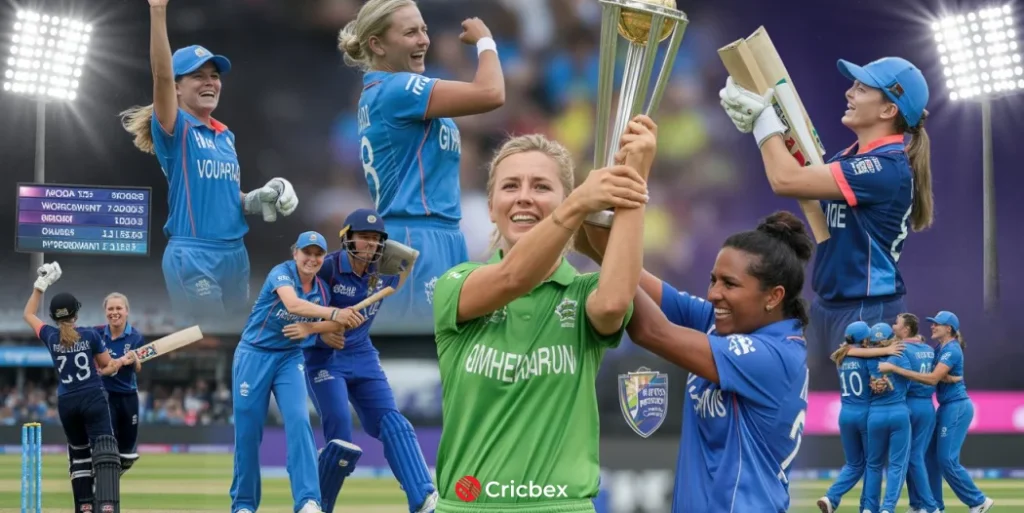
More than titles and scorecards, the Women’s ODI World Cup has been instrumental in transforming how the world views female athletes. The landmark 2025 edition, highlighted by India’s historic triumph, proved how rapidly the women’s game is evolving, both in intensity and global reach.
The tournament’s growing success has encouraged countries to invest heavily in better training systems, advanced facilities and the development of professional women’s leagues. Its impact extends far beyond the boundary lines, shaping a stronger future for women’s sports internationally and empowering the next generation of champions.
Conclusion
Australia and England’s early battles to India’s breakthrough title in 2025, the history of the Women’s ODI World Cup reflects a remarkable journey of determination and progress. Every edition has pushed the sport forward, inspiring young cricketers and expanding the global reach of women’s cricket.
With new nations rising and fan support growing worldwide, women’s cricket is now entering its strongest and most exciting era. As excitement builds around WPL 2026 Squads, all eyes are also on the 2029 Women’s ODI World Cup, which promises to be even bigger, more competitive, and full of unforgettable moments.