Viewers often wonder how long is lunch in Test cricket, why it is taken early on some days, delayed on others, or how long the break actually lasts. These changes can feel confusing, especially during live matches.
This guide explains everything clearly, including official rules, standard duration, timing variations, historical background, strategic importance, and real match examples.
By understanding how the lunch break works, fans can better follow match flow, team decisions, and key turning points during a Test match.
What Is the Lunch Break in Test Cricket?
In Test cricket, each match day is divided into three main sessions: the morning session, afternoon session, and evening session.
The lunch break takes place between the morning and afternoon sessions. It is the first long break of the day and is very important for players.
During this time, players rest their bodies, eat meals to regain energy, and recover after a long morning of play. Teams also use the lunch break to discuss tactics, review performance, and plan strategies for the next session.
This break helps players return refreshed, focused, and ready to perform better in the afternoon session.
Duration of Lunch Break in Test Cricket
The standard lunch break duration in Test cricket, giving players enough time to rest, eat, recover energy, and prepare mentally for the next session of play.
- 40 minutes (as per ICC Playing Conditions)
Other Breaks for Comparison:
- Tea Break: 20–25 minutes
- Drinks Break: 2–3 minutes
The lunch break time during a Test match is the longest interval of the day, providing players with a well-deserved pause to rest and refuel before the next session.
Official Rules for Lunch Break Timing
The lunch break in Test cricket is controlled by the ICC Playing Conditions and the MCC Laws of Cricket to ensure fairness, similar to how match timings are organized in the ICC T20 World Cup Schedule.
Under normal circumstances, lunch is taken after two hours of play, usually after around 115 overs, and the break lasts 40 minutes.
If a batting side is bowled out within 30 minutes before the scheduled test match lunch time, umpires may call lunch immediately.
Lunch timing can also change if play is affected by rain, bad light, or slow over rates.
In such situations, umpires have full authority to delay lunch, take it early, or adjust session lengths so that neither team gains an unfair advantage and the match schedule remains balanced.
Why Lunch Break Time Matters in Test Cricket
Lunch in Test cricket is not just about eating food. It has a direct impact on how the game is played and how players perform after the break.
Impact on Players
Batsmen
- Long morning sessions can cause fatigue
- Short sessions may leave them eager to continue momentum
Bowlers
- Long spells before lunch can be exhausting
- A delayed lunch reduces recovery time
Impact on Captains
- Reset field placements
- Plan post-lunch bowling spells
- Set short-term goals (e.g., early wickets)
A classic example is the 2014 Lord’s Test, where India used an early lunch to regroup and returned with a match-changing bowling performance.
Lunch Break Timing in Different Countries
Lunch time depends on local start time, not a universal clock.
| Country | Match Start Time | Typical Lunch Time |
|---|---|---|
| India | 9:30 AM | 11:30 – 12:10 |
| England | 11:00 AM | 1:00 – 1:40 |
| Australia | 10:30 AM | 12:30 – 1:10 |
| South Africa | 10:00 AM | 12:00 – 12:40 |
| Pakistan | 10:00 AM | 12:00 – 12:40 |
Lunch Break in Day-Night Test Matches
In day-night Test matches, the lunch break is replaced by a dinner break because matches are played later in the day.
The dinner break lasts 40 minutes, just like the normal lunch interval. It is usually taken between 5:00 PM and 6:00 PM, depending on the local start time and match conditions.
Even in a day-night Test match tea break time still takes place later in the evening. Teams plan their innings very carefully around the tea break, especially to avoid batting during twilight in the match.
his period can be challenging because visibility reduces and the pink ball tends to swing more under lights, making batting more difficult.
Does Rain or Bad Light Affect Lunch Timing?
Yes, weather can significantly impact lunch breaks in Test cricket.
- If play is delayed at the start, lunch may come earlier
- If rain interrupts play near lunch, umpires may take lunch immediately
- Breaks are adjusted to ensure fair rest for both teams
For example, during the WTC Final 2021 between India and New Zealand, frequent rain caused several lunch-time changes, demonstrating how officials carefully manage breaks under unpredictable conditions.
What Do Players Do During the Lunch Break?
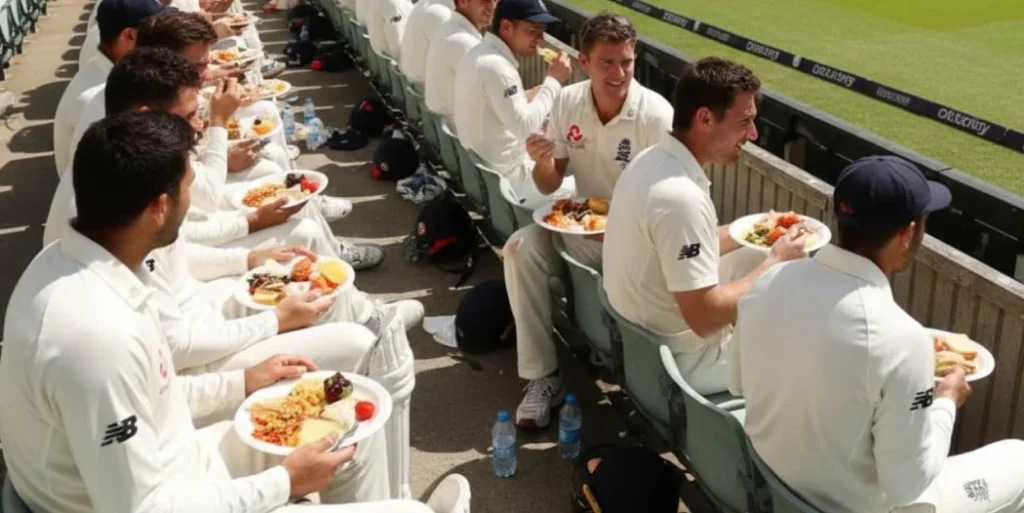
During the lunch break in Test cricket, players use the 40-minute interval to recover physically and mentally. Batsmen often eat heavier meals to refuel energy for long innings, while bowlers prefer lighter snacks to stay agile.
Players change into fresh kits and may receive physiotherapy or massages to relieve muscle strain.
Many review match footage or discuss tactics with coaches, analyzing pitch behavior and opposition weaknesses.
Captains and coaching staff use this time to plan strategies for the afternoon session, including bowling changes and field placements. Overall, the lunch break is a crucial period for rest, strategy, and preparation.
Conclusion
The lunch break in Test cricket is much more than just a meal. It plays a crucial role in shaping team strategy, maintaining player energy, and influencing the overall momentum of the game.
During this time, players recover physically and mentally, while captains and coaches plan tactics for the next session. Fans also gain insight into team decisions and the flow of the match.
Every lunch break can become a turning point, affecting how the afternoon session unfolds. Understanding its significance allows viewers to appreciate the subtleties of the game and the importance of timing and preparation in Test cricket.