Cricket is a team game where batting and bowling get most of the attention. But fielding is equally important and often decides the result of a close match. Every run saved on the field is as good as a run scored with the bat.
A good fielder in cricket can turn the game completely. One stunning catch or one sharp run-out can break the batting team’s momentum. That is why modern cricket teams invest a lot of time training across types of cricket matches to stay sharp in all formats.
Strong fielding in cricket requires sharp reflexes, good body fitness and smart positioning on the ground. A fielder must always stay alert because the ball can come to any position at any time without warning.
In this article we will explain who a fielder in cricket is, what rules they must follow, what positions exist on the field and what duties they carry out during a match.
Who is a Fielder in Cricket?
A fielder in cricket is any player from the bowling side who stands on the field to stop runs and take wickets. There are 11 players in a cricket team and all of them field together when the other team is batting. One of them is the bowler and one is the wicket-keeper.
The remaining nine players are regular fielders placed at different positions across the ground. The captain decides where each fielder stands based on the bowler bowling and the batsman at the crease.
Fielding is not just about standing in one spot and waiting for the ball. A sharp fielder in cricket uses quick reflexes, good positioning and strong throwing skills to put pressure on the batting side.
Basic Rules for a Fielder in Cricket
Every fielder in cricket must follow certain rules set by the ICC. Breaking these rules can result in penalty runs being awarded to the batting side. Let us look at the key rules every fielder must know.
Fielding Position Rules
The captain decides where each fielder stands on the ground. A fielder in cricket must stay inside the boundary line at all times during play. A fielder cannot stand within 8 yards of the batsman on strike without the umpire’s permission.
Catching Rules
If a fielder in cricket takes a clean catch the batsman is out. The fielder must have complete control of the ball and must not touch the boundary rope while completing the catch. If a fielder steps on or over the boundary while holding the ball it will be counted as a six.
Throwing and Stopping the Ball
A fielder in cricket must use only their body to stop or deflect the ball. They cannot use clothing or equipment to block it as this results in 5 penalty runs. A direct hit run-out is one of the most exciting moments in cricket.
Fielding Restrictions in Limited Overs
In limited overs cricket there are strict rules about where fielders can stand. During Powerplay overs only 2 fielders are allowed outside the 30-yard inner circle. After the powerplay ends the captain can spread fielders more freely across the ground.
Fielding Positions in Cricket Explained
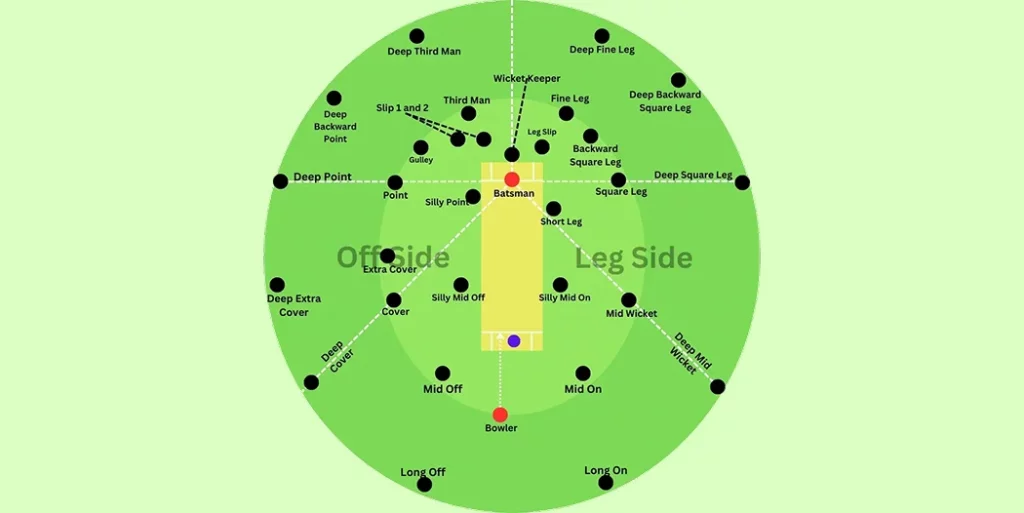
The cricket field is a large oval ground and the captain places fielders based on the batsman’s style and the bowler’s plan. There are many fielding positions in cricket and each one has a specific role to play during the match.
Close Fielding Positions
These fielders stand very close to the batsman and need sharp reflexes to react quickly. The risk of injury is higher in these spots so only alert and brave players are placed here. Common close fielding positions include:
- Slip – Stands behind the batsman on the off side and catches edges from the bat.
- Gully – Stands wider than slip and covers thicker edges that fly at an angle.
- Short leg – Stands on the leg side very close to the batsman.
- Silly point – Stands on the off side almost next to the batsman.
Inner Circle Positions
These positions are inside the 30-yard circle but not as close to the bat as slip or short leg. They are very important for cutting off singles and stopping drives. During slog overs inner circle fielders play a key role in saving quick singles.
- Mid-on – Stands to the left of the bowler near the non-striker’s end.
- Mid-off – Stands to the right of the bowler near the non-striker’s end.
- Cover – One of the busiest spots in cricket fielding rules as many drives head this way.
- Point – Stands square on the off side, cuts off cuts and punches.
- Square leg – Stands square on the leg side of the batsman.
Outfield Positions
These fielders stand close to the boundary and their main job is to stop fours and hold boundary catches. Common outfield positions include:
- Long-on – Near the boundary on the leg side behind mid-on.
- Long-off – Near the boundary on the off side behind mid-off.
- Fine leg – Behind square leg close to the boundary on the leg side.
- Third man – Behind slip on the off side near the rope.
- Deep cover – Guards the cover region near the boundary.
The cricket field setup changes based on the match situation, the bowler bowling and the batsman at the crease. A smart captain always adjusts the fielding positions to suit the game plan at every stage.
Duties of a Fielder in Cricket
A fielder in cricket has several important duties that go well beyond simply standing on the field. Here is what every fielder is expected to do during a match.
Stop the ball : The most basic duty of any fielder. In different Cricket Stadiums saving every run is critical as boundaries come at a much higher rate. Even one saved boundary can shift the momentum in a tight match.
Take catches : Catching is one of the most important skills in the game. Dropped catches are very costly and some of the best catches ever have been taken in iconic Cricket grounds around the world.
Effect run-outs : A quick throw and a direct hit on the stumps can get a batsman run out. This takes great aim and a strong arm. Top teams train specifically for this skill because it can break key partnerships instantly.
Support the bowler : When fielders save runs and take sharp catches the bowler gains confidence and bowls with more aggression. Good fielding lifts the energy of the entire team on the ground.
Apply pressure : Good positioning alone puts mental pressure on batsmen. When a sharp fielder in cricket is guarding a specific area the batsman tends to avoid that shot and takes risks elsewhere.
Conclusion
The role of a fielder in cricket is far more important than most fans realise. Sharp fielding builds pressure and helps bowlers achieve a fifer cricket by forcing mistakes from batsmen. Every catch and saved boundary directly shapes the result of the match.
Understanding cricket fielding rules and all the fielding positions helps fans appreciate how much planning goes into the fielding side of the game. A captain who sets the field smartly can control the match without taking wickets for long periods.
At the end of the day good fielding in cricket is what separates great teams from average ones. Whether it is a diving stop at cover or a stunning catch near the rope, a brilliant piece of fielding can change the entire match in just one moment.